Mary Lee
- Raven Bishop

- Mar 10
- 6 min read
Updated: Mar 12

In 1654 a woman named Mary Lee stepped aboard the ship Charity of London, headed to St. Mary's county in the colony of Maryland.
She never arrived.
The journey from England to the Maryland colony was marked by dangerously poor weather and the Charity had taken on damage. It must have been horrifying for passengers and crew aboard that ship, whose lives were at the mercy of the wind and waves.
It is unclear how the rumors started.
There was a witch on board and Mary Lee was that witch [1].
The crew repeatedly asked the ship's captain, John Bosworth, to conduct a trial at sea. He refused but did acquiesce to leave Mary in Bermuda if the ship was able to get close enough to make port [1].
One night the crew took matters into their own hands.
The crew apprehended Mary Lee and tied her to the ship's capstan. They searched her body for a witch mark and declared that one was found (though it was recounted that it was gone by morning [2]).
At some point during the assault, Mary confessed.
Having her confession, the crew asked Captain Bosworth to execute Mary Lee, which he refused amidst the vehement coercion from his crew. Some understood him to have said nothing should happen to Mary without his order [3] while others understood his order to be that they could do what they would, but only do what they could justify [2]. Bosworth retired to his cabin [2]. The men came to an agreement that what they could justify was all laying hands on Mary Lee, taking equal part in killing her [2].
Her body and possessions were thrown overboard [4].
When the Charity arrived in St. Mary's, word of a woman murdered at sea reached local magistrates. Two men were compelled to give depositions, Henry Corbyn [1 & 2] and Francis Darby [2 & 3]. A third man, Jesuit priest Father Francis Fitzherbert, gave an account of the events aboard the Charity in his letters [4].
There is no record of legal punishment for Mary's murder.
Why Mary's Story Matters Today
Let's be very clear about what happened here. This was not a witch trial.
Let's call this what it is. It was sexual assault and murder.
To cloak the events that took place aboard the Charity of London in the procedural language of "trial" and "execution" is absurd. To put the finest of points on this...touching a woman's body without her consent is sexual assault. This is true today and especially true in 1654 when a group of men searched Mary Lee's body for a witch's mark. To be clear, she was not executed, she was murdered by a mob of men.
The historic record does not reflect any companion for Mary Lee, either aboard the ship nor awaiting her in Maryland. Aside from the depositions of Corbyn and Darby, nobody came forth to say "Hey, you killed my (wife, sister, daughter, indentured servant, etc.)". So, we can assume that Mary was traveling alone; a dangerous and uncommon thing for a woman to do in 1654.
For the women reading this: How many times have you been told not to travel alone as a woman?
To travel to the colonies in 1654 was no small undertaking. Mary Lee would have boarded the Charity knowing that she would be staying for some time, and may never return to England again. We don't know what Mary's intentions for her life in the colonies were, but she would have packed for the trip. She would have brought valuable goods along with her, perhaps clothing, linens, tools, money, etc. She would have packed what she thought she needed for her time in this new, unfamiliar land. Father Fitzherbert's account claims that these possessions were thrown overboard along with Mary's body.
As emphatically as I possibly can, I call bullshit.
Material goods in 1654 were too valuable to dump into the ocean. Goods from England were in high demand in the colonies and would have fetched a price, even if their sale was not aboveboard. It is more likely that her possessions were stolen by the crew.
For the women reading this: How many times have you been told to hide your purse in public, to not wear fancy jewelry or display other valuables when traveling alone?
Mary Lee was a woman traveling alone, with valuable possessions. Nobody was waiting for her on the other side of the sea.
For the women reading this: How many times have you been told to make sure somebody knows where you are going at all times?
Mary Lee was the perfect target.
It has been over 370 years since Mary Lee was murdered, and yet, if you've spent any part of your life living as a woman, you can hear the messages echo in your own experience:
"Don't travel alone." "Hide your purse. Don't show your valuables." "Make sure someone knows where you are at all times."
This is why Mary's story matters today.
Because we recognize Mary's story in our own lived experiences. Over 370 years later.
Artist Statement
This artwork was crafted in memory of Mary Lee, who; though she never reached Maryland's shores, could be considered Maryland's first woman killed due to an accusation of witchcraft. The digital collage is created with layered photographs taken aboard a reconstructed historic ship, during a site of memory visit to Historic St. Mary's City. Some of the photographs that make up this collage look upward at the ship's masts and rigging, homage to Mary Lee's aspirations for a new life in Maryland. Some of the photographs were taken below deck, acknowledging where her journey and her life ended. My self portrait, as in all of the artworks in this series, is superimposed over the composition; symbolically bearing witness and acknowledging the ways in which Mary's story echo in my own experience and the experiences of women throughout Maryland, the United States and the world.
Site of Memory Visit
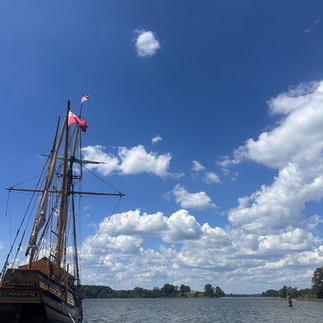
This series involves visiting sites of memory; places and spaces that the accused women these artworks honor would have known. I visited Historic St. Mary's City in 2025 as my first site of memory visit in this series. Mary Lee never arrived at St. Mary's but this is where she was headed for. I wanted to set foot on the shore she was trying to reach. I was fortunate to be able to spend time on the Maryland Dove [5], a reconstructed facsimile of a 1633 ship. The Dove is not the Charity, but it represents a similar era. A deckhand interpreter was kind enough to answer my many questions about the ship, what it would have been like to travel aboard her in the 17th century and what a capstan is (the Dove does not have one, but her description made what I read in the historical record come to life in meaningful ways).




I also spent time in the recreated courthouse at Historic St. Mary's City. Though this is a reconstruction, it is located not far from its original site. Corbyn and Darby would have given their depositions a place similar to this. Just beyond the recreated courtroom is a view of the shore, Mary Lee's intended destination. The gravity of standing in this place of "justice" yards away from the shore, a symbol of where Mary would have wanted to land, the injustice of it all sank in during the quiet time I spent alone in the chamber.




Ceremonialist Work
Spending time at a site of memory is a ritual unto itself. My ceremonialist work in this space was personal and quiet, meant for myself and the memory of the accused alone. It involved lighting the three battery-operated LED candles I'm using in this series to honor the accused. I placed these in an upper windowsill of the courthouse, only for a moment, while I sat overlooking the shoreline and meditating on Mary Lee and Elizabeth Richardson's fates.
At the shoreline, I left an offering of rose petals and tobacco for these women and collected a jar of water which I intend to use in paintings and sketches as I continue this work.


What is remembered lives.
References
Proceedings of the Council of Maryland, 1648-1655 (PDF). Vol. 3. Maryland Archives. p. 306. Retrieved August 1, 2022.
Proceedings of the Council of Maryland, 1648-1655 (PDF). Vol. 3. Maryland Archives. p. 307. Retrieved August 1, 2022.
Proceedings of the Council of Maryland, 1648-1655 (PDF). Vol. 3. Maryland Archives. p. 308. Retrieved August 1, 2022.
Russell, William Thomas. (1907). Maryland; The Land of Sanctuary. Baltimore, J. H. Furst company. p. 306-307. https://www.loc.gov/resource/gdcmassbookdig.marylandlandofsa00russ/?st=pdf&pdfPage=306
The Dove Story. Maryland Dove. https://www.marylanddove.org/history
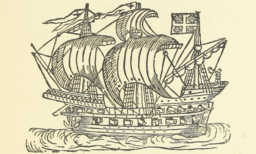
The Charity of London. Unknown illustrator and engraver (author Anthony Munday), Public domain, via Wikimedia Commons. https://commons.wikimedia.org/wiki/File:Charity_of_London_-_Ship.png


